
The "Unhappily Banked American"
(Originally published August 28, 2024)
A study of the 100 million unhappily banked in America
Entrepreneur
Approaching the concept of the 'Unhappily Banked' from the perspective of the socially challenged and economically disadvantaged reveals a deeper layer of systemic inequality and distrust in financial and legal systems. For many individuals in this demographic, which does not necessarily include only the poor, the use of cash is not merely a preference but a necessity, driven by experiences of marginalization and a lack of access to resources that wealthier individuals or corporations may take for granted. Let’s break this down.
The Socially Disadvantaged and the "Unhappily Banked"
Systemic Disadvantages and Financial Vulnerability
Economic Inequality:
Many of the "unhappily banked" belong to middle and lower-income brackets where financial stability is precarious. The cost of legal representation, the complexity of navigating the legal system, and the inability to afford competent financial advice often leave these individuals vulnerable. They may be more likely to experience garnishments, asset freezes, wrongful liens and other legal actions that can strip them of their financial independence as they have little recourse.
Legal Disadvantages:
In the U.S. legal system, those without sufficient financial resources often find themselves at a significant disadvantage. Public defenders, while essential, are often overburdened, leading to less favorable outcomes for those relying on them. The perception (and often reality) that the system is rigged against them drives many to withdraw from formal financial systems, turning to cash as a protective measure.
Distrust of Institutions:
A profound mistrust of financial institutions and the legal system is common among the economically challenged. This mistrust is born out of repeated experiences where "the system" fails to serve their interests, instead appearing to protect those with more power and resources. For example, a single adverse legal judgment, such as a garnishment order, can have devastating effects on a person's financial stability, reinforcing their reliance on cash to avoid further exposure.
Cash as a Tool for Autonomy and Survival
Preserving Financial Autonomy:
For the economically challenged, cash provides a sense of control over their finances that the formal banking system does not. In a world where bank fees, overdraft charges, and sudden account freezes can push someone deeper into poverty, cash offers a straightforward, transparent way to manage limited resources. Banks have also been anti-cash friendly to say the least.
Avoiding the Digital Trap:
In a digital economy, transactions are tracked, data is collected, and financial behavior is scrutinized. For those who have faced right or wrongful legal and financial hardship, this transparency can be a liability. Cash transactions, on the other hand, offer a level of choice and discretion that is crucial for individuals trying to navigate a system they perceive as hostile.
The Role of Smart ATM™ and Alternative Financial Services (AFS)
Serving the Underserved:
The Smart ATM™ motto, "serve the underserved," is particularly resonant for the "unhappily banked." These individuals need financial services that respect their need for choice, autonomy, and control over their resources. Smart ATM™ can play a vital role in providing a bridge between the cash-based economy they rely on and the digital economy that increasingly dominates. They still adhere to AML and KYC regulations and protections while they provide a vital and needed service.
Empowerment through Access:
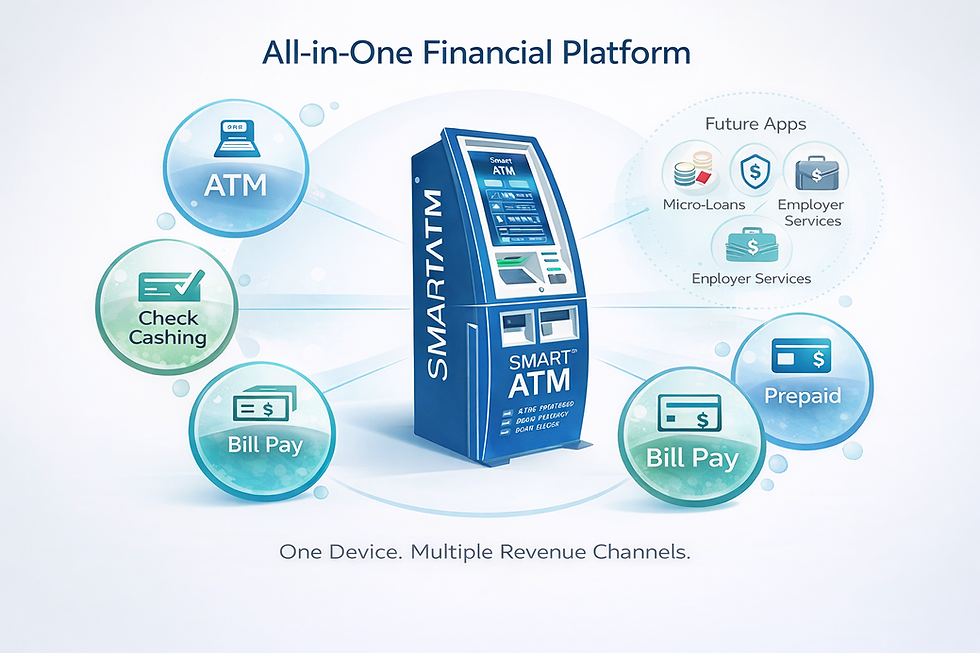
By offering services that cater to cash users, such as cash loading prepaid cards, bank withdrawal, bill payments, sending money and other essential financial services, Smart ATM™ can empower the "unhappily banked" to participate more fully in the economy without sacrificing their autonomy. This is especially important in areas where traditional banking services are either inaccessible or untrusted.
Building Trust through Technology:
Leveraging technology to create transparent, fair, and user-friendly financial services can help rebuild trust among the socially disadvantaged. For instance, offering clear, low-cost services without hidden fees or complicated terms can make a significant difference. Smart ATM™ serves multiple needed services in one kiosk and can position itself as a trusted partner for those who feel alienated by the traditional banking system.
Addressing the Broader Social and Economic Implications
Social Equity and Inclusion:
The economically challenged "unhappily banked" represent a significant portion of the population that is overlooked and virtually undefined by traditional financial institutions. Addressing their needs is not just about offering a service; it's about promoting economic equity and financial inclusion. By providing them with reliable, accessible financial services, Smart ATM™ can help mitigate some of the systemic inequalities that contribute to their economic challenges and vulnerability.
Advocating for Fairer Systems:
Beyond providing services, there is also an opportunity to advocate for broader changes in the financial and legal systems that perpetuate inequality. Supporting initiatives that promote financial literacy, protect financial choice freedoms, affordable access to legal assistance and fairer banking practices can help create an environment where the "unhappily banked" feel less compelled to rely on cash as their primary means of financial autonomy.
Conclusion
The "unhappily banked" demographic within the economically challenged population is a direct reflection of systemic failures in both the financial and legal systems. For these individuals, cash is not just a medium of exchange but a lifeline that helps them navigate an often-hostile environment. By understanding and addressing their unique needs, Smart ATM™ can not only serve this underserved demographic but also contribute to greater social equity and financial empowerment.
An article by Michael J Lasky, managing director of Fintech Levers LLC.
A Smart ATM™ solution.


Comments